

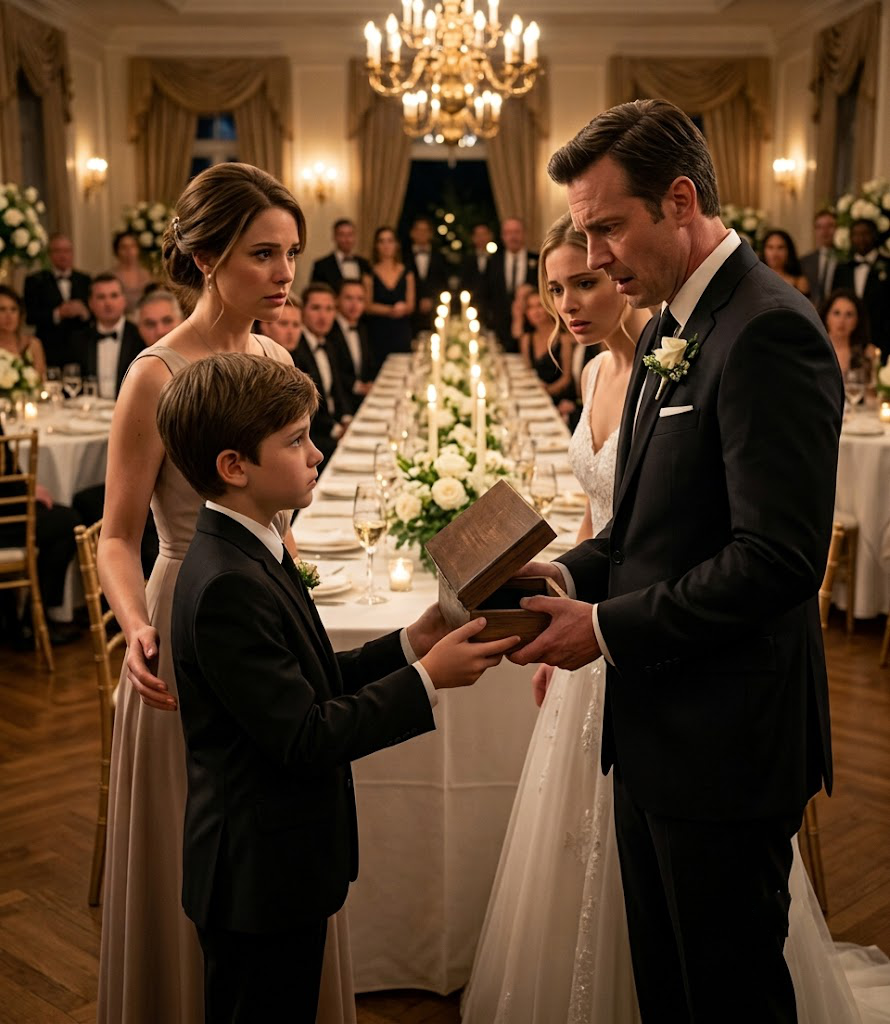
My ex-husband che@@@t33d on me, left me to raise our son, then invited us to his wedding with the other woman. During his speech, he pointed at me and said leaving that “trash” behind was the best thing he had ever done. The room filled with laughter, and I stood up to leave. But my 12-year-old son stopped me, walked straight to his father with a small box — and the moment Grant opened it, his face went white.
My name is Jenna, and eighteen months before that wedding, I still believed my marriage could survive almost anything.
Grant and I had been together for fourteen years. We had a house outside Dallas, a twelve-year-old son named Lucas, and the ordinary kind of life I had once been grateful for.
There were bills on the kitchen counter, dirty baseball uniforms soaking in the laundry room, and arguments over who had forgotten to buy milk.
Nothing about our marriage felt perfect.
But it felt real.
Then Grant started coming home later.
At first, there was always a reason. A client dinner. A meeting that ran long. Drinks with people from his law firm.
He had recently made partner, and I knew how hard he had worked for it, so I tried not to complain.
Then one Friday night, he came home after midnight smelling like a perfume I didn’t own.
When I asked about it, he looked almost offended.
“Jenna, I hugged people tonight. There were women at dinner. What exactly are you accusing me of?”
I backed down.
I wish I could say it was because I trusted him completely.
The truth was that I was afraid of the answer.
Three weeks later, I found it anyway.
Grant had left his tablet charging on the kitchen counter. A message appeared across the screen while I was packing Lucas’s lunch.
Miss you already. Last night was worth the risk.
The sender was Tessa Moore, a thirty-year-old attorney from Grant’s firm.
I stared at those words until the screen went dark.
That evening, after Lucas went upstairs, I placed the tablet in front of Grant.
He didn’t deny it for long.
He told me the usual things people say when they want their choices to sound less cruel.
We had grown apart.
He hadn’t felt understood.
He needed something different.
Tessa made him feel alive again.
I remember staring at the man I had slept beside for fourteen years and thinking that none of his sentences mentioned Lucas.
“Are you leaving?” I asked.
Grant rubbed his forehead.
“I think that’s best.”
“For whom?”
He didn’t answer.
Lucas heard us arguing anyway.
He came halfway down the stairs in his pajamas, clutching the railing.
“Dad?”
Grant turned around.
Lucas looked from him to the suitcase by the front door.
“Where are you going?”
The room became painfully quiet.
Grant walked toward him.
“Buddy, your mom and I are going through some things.”
Lucas’s face changed.
“Are you coming back tomorrow?”
Grant hesitated for less than a second.
That was enough.
I saw our son understand something before either of us had explained it.
Grant eventually said, “I’ll see you this weekend.”
He didn’t.
That became the pattern of the next year and a half.
Grant always had a reason.
He promised to come to Lucas’s first baseball game of the season and texted twenty minutes before it started.
Client emergency. Tell him I’m sorry.
Lucas kept glancing toward the parking lot between innings anyway.
A month later, Grant promised to attend the school science fair.
Lucas had spent three weeks building a model bridge from thin wooden sticks. He practiced his explanation at our kitchen table every night until I could repeat the entire thing from memory.
The morning of the fair, he asked me twice whether his father had confirmed.
“He said he’ll be there,” I told him.
At six-thirty, every family was crowded into the school gym.
At six-forty, Lucas looked toward the doors.
At seven, he stopped looking.
Grant never came.
His father, Walter, did.
Walter was seventy-one then, tall and thin, with silver hair and an old leather jacket he wore everywhere. He arrived breathless because he’d driven across town in evening traffic.
“Did I miss it?”
Lucas’s whole face changed when he saw him.
“No, Grandpa. Come look.”
Walter stood beside Lucas’s project for nearly forty minutes, listening as if a twelve-year-old’s wooden bridge were the most important construction project in Texas.
On the drive home, Lucas asked me, “Did Dad forget?”
I gripped the steering wheel.
“I don’t know, sweetheart.”
“He always has work when I have something.”
There was no safe answer to that.
I never wanted to make Lucas hate his father.
So even when I was angry, I kept my words careful.
When Grant was late, I said he was late.
When he canceled, I said he canceled.
I didn’t tell Lucas what I thought about it.
I figured Grant’s choices would eventually speak for themselves.
They did.
By the time Lucas turned twelve, he had stopped waiting by the front window.
That hurt more than watching him wait.
Walter noticed too.
He began showing up more often.
Baseball games.
School events.
Sunday lunches.
Sometimes he’d pick Lucas up and take him fishing at a lake about forty minutes away.
Grant complained once.
“You’re making me look bad,” he told his father.
Walter stared at him.
“No, son. I’m standing where you left an empty seat.”
Grant didn’t speak to him for nearly two weeks after that.
Eight months before the wedding, Walter became seriously ill.
The decline was fast.
Lucas spent every weekend he could with him.
One afternoon, I went to pick Lucas up and found the two of them sitting on Walter’s back porch.
Walter had taken off the silver watch he’d worn for as long as I had known him.
Lucas was turning it over in his hands.
“What are you two doing?” I asked.
Walter smiled.
“Teaching this boy that a watch is more than something that tells you you’re late.”
Lucas rolled his eyes.
“Grandpa says everything has a lesson.”
“That’s because your grandfather likes hearing himself talk.”
Walter laughed.
Then he looked at Lucas again.
“Remember what I told you.”
Lucas nodded.
At the time, I didn’t ask what he meant.
A few weeks later, Walter passed away.
Lucas took it badly.
Grant took it badly too, although in a different way.
He handled the funeral arrangements, spoke to the attorney, organized the house, and focused on practical things.
A few days after the funeral, I overheard Grant asking his mother, Margaret, about Walter’s watch.
“Dad always said I’d have it one day.”
Margaret was quiet.
Then she said, “Your father decided where he wanted it to go.”
Grant frowned.
“What does that mean?”
“It means exactly what I said.”
He asked again later.
Margaret never gave him another answer.
Then, three weeks before Grant’s wedding, an ivory envelope arrived at my house.
The invitation looked expensive enough to frame.
Grant Parker and Tessa Moore request the pleasure of your company…
I almost laughed.
The woman he had been seeing before our marriage ended was now becoming his wife, and apparently Grant thought inviting his ex-wife was a sign of maturity.
I put the invitation on the kitchen counter.
Lucas found it after school.
“Dad’s getting married?”
“Yes.”
“To Tessa?”
“Yes.”
He studied the card.
Then he looked at me.
“Are we invited?”
“Apparently.”
“Are we going?”
“I wasn’t planning to.”
He sat down.
“I want to.”
That surprised me.
“Why?”
Lucas ran a finger along the edge of the invitation.
“Dad tells people you make everything hard.”
My stomach tightened.
“What does he say?”
Lucas shrugged.
“He says you change plans. He says that’s why he doesn’t see me as much.”
I had to take a second before answering.
“Lucas, I’ve never stopped your father from seeing you.”
“I know.”
“How?”
“Because I’m here when he doesn’t come.”
The answer was so simple that it hurt.
Lucas looked down again.
“I want to go to the wedding.”
“You don’t have to prove anything.”
“I know.”
“Then why?”
He thought about it.
“I want to see who he is when everybody’s watching.”
That sentence stayed with me.
In the end, I agreed.
A week before the wedding, Margaret asked Lucas to spend Saturday afternoon with her.
When he came home, he carried a small package wrapped in brown paper.
“What did Grandma give you?”
“Something Grandpa left.”
He took it upstairs before I could ask more.
Two nights later, I found him at the dining room table surrounded by photographs.
His baseball uniform.
His science fair.
Christmas morning.
His eleventh birthday.
Walter beside him at the lake.
“What are you making?”
Lucas quickly closed the scrapbook in front of him.
“A wedding gift.”
“For Dad?”
“Yes.”
“Can I see it?”
“No.”
I raised an eyebrow.
Lucas smiled for the first time all evening.
“You’ll see.”
Then he asked, “Mom, do you remember what Grandpa used to say about time?”
I did.
“Time is what we give the people we love.”
Lucas nodded and wrote it down.
That should have told me something.
I simply didn’t understand yet.
Grant and Tessa were married at a country club outside Dallas.
Everything was beautiful.
White flowers lined the entrance. A string quartet played near the ceremony space. The ballroom had tall windows, crystal lights, and more guests than I had expected.
Grant loved impressive things.
He liked restaurants where people knew his name, cars people noticed, and offices with views high enough to remind everyone he’d made it.
The wedding looked exactly like him.
When Lucas and I arrived, Grant seemed genuinely surprised.
“You came.”
“You sent an invitation.”
His smile tightened for half a second before he turned to Lucas.
“There he is.”
Grant opened his arms.
Lucas let him hug him, but he didn’t hug back with the same excitement he once had.
“You look good, buddy.”
“Thanks.”
“You excited for me?”
Lucas glanced toward Tessa.
“I guess.”
Grant laughed as though Lucas had made a joke.
Tessa came over a few minutes later.
I had met her only twice before, both times after my marriage ended.
She looked beautiful in her dress, and I had no reason to pretend otherwise.
“Jenna,” she said carefully. “I’m glad you came.”
I gave her a small nod.
Lucas answered before I could.
“Dad invited us.”
Something passed across her face.
Then it was gone.
During the ceremony, I tried to focus anywhere except on Grant.
Lucas didn’t.
He watched his father make promises about loyalty and standing beside someone through every part of life.
I wondered what he was thinking.
At the reception, Lucas and I were seated near the back with distant relatives and several people from Grant’s office.
Close enough to be seen.
Far enough away not to matter.
Under Lucas’s chair was the brown package.
Dinner passed quietly.
Then the speeches started.
Tessa’s sister spoke.
Her father spoke.
One of Grant’s friends told a story about college that made everyone laugh.
Then Grant took the microphone.
He thanked everyone for coming and talked about second chances.
At first, I barely listened.
Then his tone changed.
“For years, I thought life had to be hard,” he said. “I thought you were supposed to keep carrying things just because you’d carried them for a long time.”
People nodded.
He looked at Tessa.
“Then I met this woman, and she taught me that sometimes you have to stop holding onto things that should have been thrown away years ago.”
There was scattered laughter.
My stomach turned.
Grant smiled.
Then his eyes found me.
“I can say this now because enough time has passed.”
I already knew I wasn’t going to like what came next.
He lifted his champagne glass.
“Leaving that trash behind was the best thing I ever did.”
The ballroom erupted.
Some people laughed because they understood exactly who he meant.
Others probably laughed because everyone around them was laughing.
Tessa covered her mouth, smiling.
I felt heat rush into my face.
For a few seconds, I couldn’t move.
Grant kept talking.
“Sometimes you’ve got to clear out the old mess before something better has room to come into your life.”
More laughter.
Then people began looking toward our table.
That was when some of them realized I was sitting there.
I pushed my chair back.
“We’re leaving.”
Lucas caught my hand.
“Mom.”
“Come on.”
“Wait.”
“No, Lucas.”
“Please.”
His eyes were wet, but his voice was strangely steady.
“Let me do something.”
Before I understood what he meant, he bent down, picked up the brown package, and started walking toward the bridal table.
Grant saw him coming.
“Well,” he said into the microphone, still smiling, “looks like my son wants to say something.”
Lucas stopped in front of him.
“Can I have the microphone?”
Grant handed it over.
Lucas placed the package on the table.
“I brought you a wedding gift, Dad.”
Grant grinned at the guests.
“See? At least somebody came prepared.”
Lucas didn’t smile.
He pushed the package toward him.
Grant tore off the paper.
Inside was a small wooden box.
The moment he opened it, his face went white.
“Where did you get this?”
The laughter disappeared.
Inside the box was Walter’s silver watch.
Grant stared at it as if he couldn’t understand what he was seeing.
“That was Dad’s.”
“I know.”
Grant looked at Margaret across the room.
“Mom?”
She didn’t answer.
Lucas spoke instead.
“Grandpa left it to me.”
Grant’s jaw tightened.
“That watch was supposed to come to me.”
Lucas looked directly at him.
“No, Dad. Grandpa decided where it belonged.”
Then Lucas pointed into the box.
Under the watch was an envelope.
Grant pulled it out.
His father’s handwriting was across the front.
His hands began to shake.
Lucas held out his hand.
“Grandpa gave Grandma permission to let me read it when I was ready. I brought a copy. Can I read it?”
Grant said nothing.
Lucas took the page and faced the room.
The letter was short.
Walter had written that Grant might believe a watch was something valuable because of what it cost.
But that wasn’t why he’d kept that particular one for nearly forty years.
A watch measured time.
And time, Walter wrote, was one of the few things a man could give his family that money could never replace.
He told Grant he had always been proud of his career.
But he had also watched his son become so busy chasing the next success that he began treating the people who loved him as if they would always be waiting when he finally had time.
Walter wrote about Lucas.
The baseball games.
The science fair.
The birthdays.
He reminded Grant that children didn’t stay children until their parents were ready.
One day, there would be no next game.
No next school event.
No next twelve-year-old birthday.
Walter had left the watch to Lucas because Lucas already understood how much it mattered when someone simply showed up.
By the time Lucas finished, nobody in the ballroom was moving.
Grant stared at the floor.
But Lucas wasn’t finished.
He reached into the brown package and pulled out the scrapbook I’d seen at our dining table.
Across the front he’d written:
THE TIME YOU MISSED.
Grant looked at him.
“Lucas…”
Lucas opened the first page.
It showed him standing beside his science fair bridge.
Under the photograph he’d written:
Dad said he had a meeting. Grandpa came.
The next page was his eleventh birthday.
Dad said he’d come after dinner. I waited until 10:20.
Another page showed him in his baseball uniform.
My first double. Mom was there.
Christmas morning.
Dad called in the afternoon.
School concert.
Grandpa sat in the seat we saved for Dad.
I pressed my fingers against my mouth.
I’d known Lucas was hurt.
I hadn’t known he had counted everything.
Grant turned page after page.
His face changed with each one.
Finally, Lucas closed the book.
“I didn’t make this because I hate you.”
Grant looked up.
Lucas swallowed.
“I don’t hate you, Dad. I miss you.”
Grant’s eyes filled.
“But you tell people Mom keeps me away from you.”
My head snapped toward him.
Grant didn’t look at me.
Lucas continued.
“She doesn’t.”
Tessa slowly turned toward her new husband.
Lucas tightened his grip around the microphone.
“Mom reminds me to answer your calls. She tells me when it’s your birthday. She packs my stuff when you say you’re picking me up, even when she knows you might not come.”
His voice cracked.
“And when you don’t come, she never tells me you’re a bad person.”
Grant opened his mouth.
Lucas didn’t let him speak.
“So when you called her trash and everybody laughed, you weren’t just making fun of her.”
His eyes finally filled completely.
“You were making fun of the person who stayed every time you didn’t.”
The room was silent.
I couldn’t stop the tears that came then.
Lucas looked toward me.
“She was there when I was sick. She came to every game. She stayed up helping with homework after working all day. She sat with me when I thought maybe Dad didn’t want me anymore.”
Grant lowered his head.
Lucas looked back at him.
“So no, she’s not trash.”
His voice was quieter now.
“She’s my mom.”
He opened the scrapbook again.
Near the back were six empty pages.
Grant frowned at them.
“What are those?”
Lucas held the book toward him.
“Those are your wedding gift.”
Grant looked confused.
“The blank pages?”
Lucas nodded.
“They’re for things that haven’t happened yet.”
For the first time since Lucas had walked toward him, Grant seemed to have no idea what to say.
“If you still want to be my dad,” Lucas continued, “you can fill them.”
He set the scrapbook beside Walter’s watch.
“That’s up to you.”
Then he handed the microphone back.
Margaret was the first person to move.
She wrapped Lucas in her arms, and that was when my son finally cried.
I went to him.
Behind us, Grant still stood beside the bridal table.
Tessa had gone pale.
She looked at him.
“You told me Jenna stopped you from seeing Lucas.”
Grant’s shoulders stiffened.
“Tessa, not now.”
“You said she changed the schedule every time you tried.”
Several people nearby heard her.
So did I.
Grant looked toward me.
I could have pulled out my phone.
I had enough unanswered texts to destroy every excuse he’d made.
Are you still getting Lucas Friday?
His game starts at six.
Please call him. He thinks he did something wrong.
I didn’t need them anymore.
“I never stopped you from seeing your son,” I said.
Grant couldn’t meet my eyes.
Tessa looked devastated.
Not because she’d suddenly discovered our marriage had been perfect.
It hadn’t been.
She looked devastated because she had just realized how many lies had been useful to both of them.
“I believed him,” she said quietly.
I nodded.
“That was your choice.”
Grant stepped toward Lucas.
“Buddy, I didn’t mean—”
Lucas moved back.
Only one step.
It was enough to stop him.
Grant swallowed.
“I was joking.”
Lucas wiped his face.
“Then why wasn’t Mom laughing?”
Grant had no answer.
Lucas took Walter’s watch from the box and fastened it around his wrist.
Then he turned to me.
“I want to go home.”
We left without another word.
On the way back, Lucas asked if we could stop for pie.
So just before midnight, still dressed for a wedding, we sat in a twenty-four-hour diner with two slices of apple pie between us.
Lucas had taken off his tie.
I had kicked off my heels under the table.
For a while, neither of us spoke.
Then I asked, “How long were you planning that?”
“Since Grandma showed me Grandpa’s letter.”
“You scared me.”
“Sorry.”
“I thought you were going to throw something at your father.”
That finally made him laugh.
Then the smile disappeared.
“Do you think Dad loves me?”
It was the question I had spent eighteen months hoping he wouldn’t ask.
I reached across the table.
“I think he does.”
Lucas watched me.
“But loving somebody doesn’t automatically make you good at taking care of them.”
He looked down at Walter’s watch.
“So what happens now?”
“I don’t know.”
“What if he wants another chance?”
“Then he has to show you what that means.”
Grant called the next morning.
I didn’t answer.
He texted instead.
I’m sorry for what I said about you.
A few minutes later another message appeared.
And I’m sorry for what I’ve done to Lucas. There isn’t an excuse.
That sentence got my attention.
Grant always had an excuse.
Two days later, I agreed to meet him at a coffee shop.
He looked exhausted.
For several seconds, he just stared at his hands.
Then he said, “I’ve been lying.”
“I know.”
“I told people you made seeing Lucas difficult.”
“Yes.”
“I told Tessa that too.”
I waited.
Grant rubbed his face.
“If I admitted you were a good wife and that you never kept my son from me, then I had to admit what I actually did.”
“And what was that?”
He looked at me.
“I blew up my family because I wanted something new, and then I became the kind of father I always swore I’d never be.”
For once, there was no blame hidden inside his apology.
“I made you the bad guy because it made me feel better about myself,” he said.
I didn’t tell him everything was okay.
It wasn’t.
“If you want a relationship with Lucas, don’t promise him anything today.”
Grant frowned.
“What am I supposed to do?”
“Show up.”
He nodded.
“That’s it?”
“No. It’s just harder than it sounds.”
Two weeks later, Lucas had a baseball game.
Grant arrived forty minutes early.
He sat on the bleachers with a bottle of water.
No gifts.
No big speech.
When Lucas noticed him during warmups, he stared for several seconds.
Then he looked at me.
I simply said, “He came.”
Grant stayed until the last inning.
Afterward, he walked over.
“Nice double.”
Lucas gave him a cautious smile.
“Thanks.”
That became the first new photograph in the scrapbook.
A month later, Grant attended a school presentation.
Another page.
Then a parent-teacher meeting.
Another.
For Lucas’s thirteenth birthday, Grant asked what he wanted.
Lucas said, “Nothing expensive.”
So Grant took him fishing at the lake where Walter used to take him.
There were still mistakes.
Once Grant wrote the wrong pickup time and left Lucas waiting on the porch.
Twenty minutes later, my phone rang.
The old Grant would have blamed traffic or a client.
Instead, he said, “I messed up. I wrote down the wrong time. Tell Lucas I’m sorry. I’m already on my way.”
Lucas was angry when Grant arrived.
I didn’t tell him not to be.
Trust wasn’t supposed to return because his father finally learned how to apologize.
It returned slowly because Grant kept coming back.
Tessa eventually asked to meet me too.
“I owe you an apology,” she said.
I waited.
“I believed Grant because it was easier to believe you were the problem.”
At least she didn’t dress it up.
“If you were awful,” she continued, “then I didn’t have to think very hard about what it meant that our relationship started before your marriage was over.”
I appreciated the truth more than I would have appreciated a pretty apology.
Tessa and I never became friends.
We didn’t need to.
But she stopped treating Lucas like an uncomfortable reminder of Grant’s old life.
She understood that he wasn’t the old life.
He was his son.
Two years later, Lucas turned fifteen.
We had burgers and cake in my backyard.
Margaret came.
Grant came.
Tessa came.
At one point, I stood at the kitchen window and watched Grant helping Lucas repair the chain on his bike.
They were arguing about which tool to use.
Lucas said something I couldn’t hear.
Grant laughed.
Then Lucas laughed too.
It wasn’t the careful laugh he’d used around his father for years.
It was easy.
That mattered to me more than any apology Grant had ever given.
Later, Grant came inside and held out his phone.
“Look.”
It was a picture of the scrapbook.
The six blank pages weren’t blank anymore.
Baseball.
Fishing.
A school award.
A camping trip.
A ridiculous selfie of Grant and Lucas soaked in the rain.
“He gave it back to me last month,” Grant said.
I smiled.
“He did?”
“He said I’m supposed to keep filling it.”
Grant looked out the window at our son.
“I wasted a lot of time.”
“Yes, you did.”
He gave me a tired smile.
“You’re never going to make this easy for me, are you?”
“No.”
He laughed softly.
Then his face became serious.
“Thank you for never making him hate me.”
I looked at Lucas.
“That was never mine to decide.”
Before everyone left that evening, Lucas came into the kitchen looking for his phone.
Walter’s watch was on his wrist.
He only wore it on days that mattered to him.
I touched the old silver band.
“Your grandfather would have liked today.”
Lucas smiled.
“I think so too.”
Then he glanced through the window at Grant.
“Grandpa was right.”
“About what?”
Lucas tapped the watch.
“Time.”
I knew what he meant.
That night at Grant’s wedding, my son could have used that microphone to humiliate his father the way his father had humiliated me.
He didn’t.
He simply showed Grant what twelve years looked like when you counted the days someone failed to show up.
The watch wasn’t what changed him.
Neither was the letter.
It wasn’t even the shame of standing in front of a room full of people with nowhere left to hide.
It was those six empty pages.
Lucas couldn’t give his father back the games he’d missed or the nights he’d spent waiting beside the window.
But he could show him that there was still some time left.
Whether Grant deserved that time was no longer something he could explain with promises.
He had to prove it.
One ordinary day at a time.